- A Podcast to the Curious: Randalls Round by Eleanor Scott
- A Podcast to the Curious: Count Magnus Awakens
- SFFaudio Podcast: The Long Tomorrow by Leigh Brackett
- SFFaudio Podcast: Orphans Of The Sky by Robert A. Heinlein
- SFFaudio Podcast: Strawberry Spring by Stephen King
- Lovecraft eZine Videocast: Ellen Datlow
- Mega City Book Club: Dr. Mesmer's Revenge
- Mega City Book Club: The League Of Extraordinary Gentlemen
- Cult Connections: Edgar Wallace: Giant of Cinema
- The Folklore Podcast: English Folktales (with Neil Philip)
- The Cromcast: Pulp Weirdos! & Robert E. Howard's Poetry Pals
- Appendix N Book Club: P. Djèlí Clark’s A Master of Djinn with special guest Maxwell Lander
- The Great Derelict: A look back at Andor
- The Twilight Zone Podcast: Bill Mumy Interview
- From the Great Library of Dreams: Holly by Marc Damian Lawler
- From the Great Library of Dreams: The Water Ghost of Harrowby Hall by John Kendrick Bangs
- From the Great Library of Dreams: All Through the House by Jim Moon
- Hypnogoria: The Oldtime Yuletide Advent Calendar
- NUTS4R2 bespricht Don’t Open ‘Til Christmas * The Dark Side Of Christmas * Silent Night * The It's A Wonderful Life Book * Demonic Christmas Tree * Alvin And His Pals In Merry Christmas Dell Giant * Christmas Bloody Christmas * Hudson Hawk * Troll * The Case Of The Lucky Legs * Pleasure * Livid * Sabata
- NUTS4R2's 2022 Favourite Movies
- Movies Silently: The First Auto (1927) A Silent Film Review von Fritzi Kramer
- Movies Silently: Betsy Ross (1917) A Silent Film Review
- Movies Silently: Kean (1910) A Silent Film Review
- Movies Silently: Something Good (1898) A Silent Film Review
- Hallo, hier spricht ... Ann Smyrner (03 Nov 1934 - 29 Aug 2016) & Tim Bergfelder: International Adventures von Holger Haase
- The Reprobate: The Absurd World Of Joe D’Amato von David Flint
- The Reprobate: The Magnificent Melodrama Of Vittorio de Sica’s Sunflower
- Cinematic Catharsis: Burden of Dreams * Documentary December Quick Picks and Pans
- The Last Drive In: 31 Flavors of Noir on the Fringe to Lure you in! Part 3
- The Last Drive In: Elisha Cook Jr. – Like it says in the newspaper I’m a bad boy
- Fangoria: A Guide To Hong Kong Category III Shockers: Leading Ladies von Simon Abrams
- Ghouls Ghouls Ghouls: The Happy Death Day films and the Grieving Process von Reyna Cervantes
- Ghouls Ghouls Ghouls: "Dreadful, Mad Hunger”: The Danger of Silence in The Woman In Black (1989) von Caitlyn Downs
- CrimeReads: Mr. Inbetween: It's Time to Appreciate the Genius of This Very Australian Noir von Andrew Nette
- Scifist 2.0: The Beast of Hollow Mountain
- Once Upon A Screen: Edna May Oliver: She Had a Long Face and She Stuck It Where She Wanted
- Ellsworth's Cinema of Swords: Samurai Stocking Stuffers
- FragmentAnsichten: Coming of Age mit lauernden Monstern von Alessandra Reß
- FragmentAnsichten: Kulturelles Flimmern 2022 & [Random 7] Gelesene Bücher 2022, Part 2
- Deep Cuts in a Lovecraftian Vein: Deeper Cut: Spirits of Bigotry Past & Present: H. P. Lovecraft & J. K. Rowling von Bobby Derie
- Deep Cuts in a Lovecraftian Vein: Her Letters To Lovecraft: Bernice Nette (Leach) Barlow
- Deep Cuts in a Lovecraftian Vein: Satan’s Servants (1949) by Robert Bloch * Last Rites for a Dead Druid (1972) by Alvin Sapinsley * The Day of the Stranger (1947) by Novalyne Price Ellis * The Old Ones Reborn (2007) by Erin Donahoe
- Strange Horizons: The Myriad Drumbeats of Afrofuturism: Who is an Afrofuturist? Answers from (African) Francophone Authors
- Cambridge University Library Special Collections: A New Year’s Eve Ghost Story
- Nightmare Magazine: The H Word: A Celebration of Sonic Horror von Eric Raglin
- Dark Worlds: The Fantastic in the Argosy: 1940 * 1941 and Beyond
- Dark Worlds: Giant and Killer Insects in the Pulps II
- Apex Magazine: Interview with Artist Andrew McIntosh
- Apex Magazine: Interview with Author Isabel J. Kim
- Clarkesworld Magazine: Pausing to Think: A Conversation with Ada Hoffman
- Clarkesworld Magazine: Relentless Curiosity: A Conversation with Paul McAuley
- Black Gate: The World’s Greatest Paranormal Investigator:Hellboy by Mike Mignola and Sundry Hands von Fletcher Vredenburgh
- Dark Worlds: Monsters Unleashed – Hidden Sword & Sorcery
- Dark Worlds: Sword & Sorcery at Warren – Part 1: The 1960s * Part 2: 1970 * Part 3: 1971
- Attack of the 50 Year Old Comic Books: Tomb of Dracula #7 (March, 1973)
- Attack of the 50 Year Old Comic Books: Sword of Sorcery #1 (February, 1973)
- DMR Books: Wayne Barlowe: Delights Both Infernal and Supernal
- Black Gate: The Fantastic Realms of Luis Royo von John O'Neill
- Black Gate: The Return of Lone Wolf by Joe Dever
- Myth & Moor: The folklore of winter von Terri Windling
- CrimeReads: The Most Glamorous Gang in London History von Beezy Marsh
- Skeptical Inquirer: Analysis of an Arthur Ford Séance von Loren Pankratz
- Skeptical Inquirer: The Case of the Devil’s Baby of Ravenswood von Daniel A. Reed
Sonntag, 8. Januar 2023
Strandgut

Samstag, 7. Januar 2023
Auf Abwegen zum Palast der Silberprinzessin
Im Zuge der Recherche zu einem anderen Projekt und während der damit verbundenen Lektüre von Jon Petersons Game Wizards, das mir die liebe Alessandra von FragmentAnsichten zum letzten Geburtstag geschenkt hatte, stieß ich vor einiger Zeit auf folgende kurze Passage, die mich augenblicklich aufhorchen ließ:
It did not help that Jean Wells was sidelined around this time [März 1980] due to an incident involving the module Palace of the Silver Princess, which was notoriously pulped due to objectionable content. Apart from some sexually charged imagery, it also contained an Erol Otus drawing with numerous company in-jokes and perhaps caricatures of certain TSR executives. (1)Die Frühgeschichte von D&D war bislang weitgehend Terra Incognita für mich gewesen. Aber ich konnte mich aus den 80er Jahren an die Existenz eines Moduls mit dem Titel Palast der Silberprinzessin erinnern. Selber besessen hatte ich das Heft zwar nie, dennoch machte das die Sache irgendwie noch spannender: Eine ältere Version dieses Abenteuers war also wegen "objectionable content" eingestampft worden? Wie genau hatte dieser Inhalt ausgesehen? Unter welchen Umständen war es zu dieser radikalen Entscheidung gekommen? Und war es bloß ein Zufall, dass Palace of the Silver Princess zugleich das erste von TSR veröffentlichte D&D-Modul war, das von einer Frau geschrieben worden war? Und dass Jean Wells danach nie wieder als Autorin in Erscheinung trat? Fragen über Fragen und Grund genug, sich mal wieder auf Recherche-Abwege zu begeben.
Wo beginnen? Hmm ... hier vielleicht ...
Im April 1979 verkündete Gary Gygax in #24 von Dragon Magazine die Gründung von TSR's Design Department. Im Zuge dessen seien zwei neue Mitarbeiter*innen zum Team gestoßen. Lawrence Schick und Jean Wells. Gygax kommentierte: "Jean Wells is now on the staff in order to give the game material with a feminine viewpont -- after all, at least 10% of the players are female!" (2)
Fünf Jahre zuvor hatte er noch deutlich andere Töne angeschlagen. Nach dem Erscheinen der allerersten Version von D&D im Sommer 1974 hatte Jim Dakpus in seiner Rezension des Regelwerks nämlich beklagt, dass das Erwürfeln und Spielen weiblicher Figuren darin de facto nicht vorgesehen war. Nicht zufällig trug der erste Band den Titel Men & Magic. Blättert man ein bisschen darin herum, stößt man auf folgenden Absatz:
There is no reason that players cannot be allowed to play as virtually anything, provided they begin relatively weak and work up to the top, i.e., a player wishing to be a Dragon would have to begin as let us say, a "young" one and progress upwards in the usual manner, steps being predetermined by the campaign referee.
Gygax und Dave Arneson hielten es wohl für wahrscheinlicher, dass irgendwer einen Drachen spielen wollte als eine Kriegerin oder Zauberin. Und die cartoonhaften Zeichnungen einer "beautiful witch" und einer barbusigen Amazone in hochhackigen Stiefeln, die man in dem selben Heftchen findet, dürften auch kaum dem Ziel gedient haben, ein weibliches Publikum anzusprechen.
Als Dakpus noch einmal nachhakte, ließ die Reaktion an Deutlichkeit nichts zu wünschen übrig:
I asked Gary what women’s libbers think of the situation, and he told me that he will bend to their demands when a member of the opposite sex buys a copy of Dungeons & Dragons!
War das bloß Ausdruck sexistischer Vorurteile oder hatte Gygax guten Grund anzunehmen, dass D&D nie irgendwelche Käuferinnen finden würde? Und wenn letzteres tatsächlich der Fall war, was änderte sich zwischen 1974 und 1979?
Dungeons & Dragons entstand in einem sehr spezifischen Milieu -- dem der "Wargames" - Enthusiasten. (3) Die Wurzeln dieser Spiele, bei denen die Teilnehmer in die Rolle militärischer Befehlshaber schlüpfen und ganze Armeen gegeneinander in die Schlacht schicken, reichen bis ins frühe 19. Jahrhundert (und *natürlich* nach Preußen) zurück. 1913 erschien H.G. Wells' Regelwerk Little Wars und in den 40er Jahren unterhielt sich der New Yorker Kreis um SFF-Autor Fletcher Pratt mit dessen "Naval Wargames". Zu einer eigenen, über Clubs, Conventions und Fanzines vernetzten Szene wurden die "Wargamer" in den späten 50er und den 60er Jahren, wobei das von Marktführer Avalon Hill herausgegebene Magazin The General eine wichtige Rolle spielte. Wie Jon Peterson in seinem Artikel The First Female Gamers detailliert dalegt, bestand diese Community, von wenigen Ausnahmen abgesehen, beinah ausschließlich aus Männern. Umfragen aus den frühen 70er Jahren scheinen zu belegen, dass Frauen gerade einmal 0,5% des Fandoms ausmachten. Dafür gab es sicher eine Reihe von Gründen, aber eigentlich finde ich es nicht so erstaunlich bei einem Hobby, das derart stark in den klassisch "männlichen" Traditionen des Militarismus verankert war,
Dies war das Umfeld, aus dem heraus D&D geboren wurde. Gygax und
Arneson waren passionierte "Wargamer" und gut venetzt in der Szene. Die von Gygax 1968 ins Leben gerufene GenCon ("Geneva Convention") war zu Beginn ganz "Wargames" und Miniaturen gewidmet. Chainmail, ein Regelwerk für mittelalterliche Schlachten, war die
Grundlage, auf der die ersten RPG-Szenarien aufbauten. Selbst der Name TSR ("Tactical Studies Rules") verrät deutlich den ursprünglichen Hintergrund. Und auf dem Cover der allerersten Ausgabe von D&D konnte man lesen: "Rules for Fantastic Medieval Wargames Campaigns Playable with Paper and Pencil and Miniature Figures". Der Begriff "Role Playing Game" würde sich erst etwas später durchsetzen.
Es versteht sich von selbst, dass das neue Spiel seine Käufer zu Beginn beinah ausschließlich unter alteingesessenen "Wargamern" fand. Dennoch gab es schon früh Anzeichen dafür, dass es größeren Anklang unter Spielerinnen fand als andere Produkte. Wirklich entscheidend war jedoch, dass D&D schon bald Zugang zu einer anderen Szene erhielt -- der der SF- und Fantasyfans (sowie der aus ihr hervorgegangenen "Society for Creative Anachronism"). Diese war zwar sicher auch kein egalitäres Utopia, aber auf jedenfall sehr viel diverser als die "Wargamer" - Community. Frauen bildeten zwar eine Minderheit, hatten aber von Beginn an eine wichtige Rolle in ihr gespielt.
Ein besonders schönes Beispiel dafür ist die Entwicklung, die Lee Gold zu "the industry's first female star" und "one of the ten or so most important people in the roleplaying field" der 70er Jahre machte. Es war der alte "Wargamer" Mark Swanson, der 1974 als erster die Kunde von D&D nach Los Angeles trug. Doch erst als Owen und Hilda Hannifen von San Francisco kommend das Regelwerk mitbrachten und ein paar Spielrunden organisierten, sprang der Funke wirklich über und erfasste signifikante Teile des dortigen SFF-Fandoms.
Der altehrwürdigen LASFS ("Los Angeles Science Fantasy Society") hatten schon in den 30er/40er
Jahren so bedeutende "Femme-Fans" der ersten Stunde wie
Myrtle R. Douglas ("Morojo"), Mary ("Pogo") Gray und "Tigrina" (Edythe
Eyde) angehört. Und nachdem Hilda Hannifen in APA-L, der Fanzine des Clubs, Artikel über ihre D&D - Runden zu veröffentlichen begann, gehörten weibliche Fans wie June Moffatt und Bjo Trimble zu den ersten, die ihr Interesse an dem neuen Spiel bekundeten. Ihre enthusiastischsten Konvertiten fanden die Hannifens allerdings in Lee und Barry Gold:
My husband and I were fascinated, and they lent us a photocopy of the rules, on seeing us write a check to TSR to order our own copy, so we wouldn't have to wait till the rules arrived (in a brown box) from TSR.
Schon bald füllten sich die Seiten von APA-L mehr und mehr mit Lee Golds D&D - Berichten, was bei nicht-infizierten Fans wie dem einflussreichen Bruce Pelz schließlich zu einiger Irritation führte. Und so beschloss sie, ein eigenes, ausschließlich dem Rollenspiel gewidmetes Magazin zu veröffentlichen. Im Juni 1975 erschien die erste Nummer von Alarums & Excursions. TSRs hauseigener Dragon würde erst ein Jahr später an den Start gehen. Das Magazin erfreute sich rasch eines beträchtlichen Ansehens in der jungen Szene und viele ihrer namenhafte Größen trugen über die nächsten Jahre Gastbeiträge zu ihm bei.
Zur selben Zeit wie die erste Ausgabe von Dragon erschien außerdem The Dungeoneer. Jennell Jaquays lebte und schrieb damals freilich noch als Paul -- ihr Transitioning würde erst Jahrzehnte später stattfinden. (4) In der zweiten Nummer des Fanzines erschien Jaquays' Artikel Those Lovely Ladies, der sich mit weiblichen Spielercharakteren in D&D beschäftigte. Die Art, in der dies geschah, scheint ziemlich typisch für die frühe Szene gewesen zu sein, rief aber auch umgehend Kritik hervor. Um Jon Peterson zu zitieren:
“Those Lovely Ladies” reinvented the Fighting-man, Magic-user, and Cleric classes for women as “Valkyries,” “Circeans” and “Daughters of Delphi,” respectively. It [...] awarded women a blanket Charisma bonus, though the Charisma of women suffered if their Strength was too high. This piece too received pushback from a female reader, Judith Preissle Goetz, who concedes that “women have higher charisma as far as men are generally concerned,” but observes, ”you have ignored the complementary phenomena that men have higher charisma as far as most women are concerned.” She also takes exception to the notion that high Strength would render a woman unattractive, noting that “female athletes are often more sought after than other women."Ein noch sehr viel krasseres Beispiel dafür, wie auf gut sexistische Manier "körperliche Attraktivität" zu einem zentralen Attribut für weibliche Spielercharaktere gemacht wurde, ist Lenard Lakofkas einen Monat später in Dragon #3 neu abgedruckter Artikel Notes on Women & Magic. (5) Dort wird für Kriegerinnen, Diebinnen und Zauberkundige "Charisma" gleich ganz durch "Beauty" ersetzt. Abhängig davon erhalten sie außerdem die besonderen "Fertigkeiten" "Seduce" und "Charm Men"! Der Tenor des Ganzen zeigt sich recht unverhüllt in den neuen "Stufen-Titeln" für Diebinnen: "Wench - Hag - Jade - Succubus" ... Daneben dekretierte der Artikel außerdem einen maximalen "Strength"-Wert für weibliche Charaktere, der deutlich unter dem männlicher lag.
Der Beitrag rief wütende Reaktionen im Fandom hervor. In Alarums & Excursions erschien eine Karrikatur, in der eine Gruppe von Abenteurerinnen Lakofka, Gygax und Dragon - Herausgeber Tim Kask "in effigy" aufknüpften, und Kay Jones verlieh ihrer Empörung in folgenden Versen Ausdruck:
A verse for Len Lakofka, who’s earned the name of nerd,
The Dungeoneer war außerdem Pionier im Herausgeben vorgefertigter Abenteuerszenarien. (6) Auch das ein Bereich, in dem sich schon früh eine ganze Reihe von Frauen tummelten, wenn auch meistens als Co-Autorinnen. Um einige Beispiele zu nennen: Judith Kerestan war Co-Autorin von Palace of the Vampire Queen (1976) und The Misty Isles (1977), herausgegeben von Wee Warriors; Laurie Van De Graaf von Quest for the Fazzlewood (1978), herausgegeben von Metro Detroit Gamers, und Laura Hickman von Rahasia (1979) und Pharaoh (1980), herausgegeben von DayStar West Media.
Das erste kommerziell veröffentlichte Abenteuer, das ausschließlich den Namen einer Autorin auf dem Cover trug, war Lillian "Lee" Russells Labyrinth (1978), das dritte Solo-Abenteuer für Tunnels & Trolls. Ken St. Andres bei Flying Buffalo veröffentlichte Rollenspiel war der erste "Nachahmer", der sich nach D&D zu etablieren vermochte. Es führte nicht nur das Konzept des Solo-Abenteuers ein (und gab damit den direkten Anstoß zur späteren Entstehung der Fighting Fantasy - Spielbücher), sondern schlug von Beginn an auch einen humorvolleren Ton an als D&D. Als 1978 die erste Nummer des hauseigenen Magazins Sorcerer's Apprentice erschien, schrieb St. Andre im Editorial:
Sorcerer’s Apprentice will attempt to carry the T&T philosophy of FRP gaming to a wider audience: namely that role-playing is fun. Dungeons & Dragons, despite its inherent silliness (especially in monster names and types), has somehow taken on the quasi-serious aspects of a religion. (7)
Die eigentliche prägende Kraft hinter dem Magazin war allerdings Co-Herausgeberin Liz Danforth. Sie war auch für die 1979 herausgegebene fünfte überarbeitete Fassung von Tunnels & Trolls und damit für die Form des Regelwerks verantwortlich, die für lange Zeit die defintive blieb.
Das mag kein erschöpfender Überblick sein, aber ich denke, er reicht aus, um einen ungefähren Eindruck von den Entwicklungen im frühen RPG-Fandom zu vermitteln. Aber auch wenn Frauen dort von Anfang an eine merklich größere Rolle spielten als in der alten "Wargamer" - Community, heißt dass natürlich nicht, dass sie immer willkommen gewesen wären. Zuerst einmal bildeten sie trotz allem eine kleine Minderheit. Wie Liz Danforth einmal in einem Interview erzählt hat:
My first Origins (Convention) -- which was about 1976, near as I can recall -- it seemed like every guy on the hall was staring at my chest. I was damn near the only female in the place. No one was unkind or truly rude, though. They just couldn’t believe I knew games, played games, or worked for a game company. They all figured I was somebody’s girlfriend, I think.Und wie wir ja schon am Aufruhr um den Lakofka - Artikel gesehen haben, war das Fandom natürlich alles andere als frei von Sexismus. Zum Teil zeigte sich das im D&D - Regelwerk selbst. Man denke etwa an die berüchtigte "Harlot's Table" aus dem Dungeon Masters Guide von 1979. (8) Nicht zu vergessen das Design der allermeisten Miniaturen, die die "Tradition" der oben erwähnten Illustrationen aus Men & Magic fortsetzten. Wie es Fan Judith Goetz ausdrückte:
Some of the ‘downs’ of D&D for me are in encountering men’s collections of fantasy figures whose only females are the naked sirens who serve only as so much booty – and, for that matter, the cartoons run in The Dragon that present the same view.Vor allem aber prägte der Sexismus der Zeit die Atmosphäre nicht weniger Spielgruppen. Als Jean Wells und Kim Mohan in Dragon #39 (Juli 1980) ihren Artikel Women want equality -- and why not? veröffentlichten, gaben sie darain einige der entsprechenden negativen Erfahrungen wieder, von denen ihnen D&D-Spielerinnen berichtet hatten:
Women who play female characters must be concerned […] about their characters being “used” as sex objects to further the ends of a male-dominated party of adventurers.One reader, Sharon Anne Fortier, related a story about a female dwarf character of hers that was forced by the males in the party to seduce a small band of dwarves so the party could get the drop on them and kill them.Another reader wrote of being penalized by her DM because she was a Cleric and had the misfortune (as it turned out) to become pregnant. The DM said that Lawful Good Clerics didn’t do that sort of thing, he forced the character to undergo a change of alignment, and the player eventually had to roll up a new character. [...]Laura Roslof said that the men she has been involved in gaming with seem to expect females to wait obediently by the door while they (the males) sort through the treasure. She said that wouldn’t be so bad by itself, but then the men usually refuse to provide females with a fair share of the loot.
Wie offen und frei von all dem das Umfeld war, das Jean Wells 1979 bei TSR vorgefunden hatte, muss dahingestellt bleiben.
Wells hatte D&D während eines Kanu-Trips in ihren College-Tagen kennengelernt und war schon bald Mitglied der örtlichen Fangruppe ("D&D Gang of Statesmen Complex") geworden. "I discovered I enjoyed running more than playing. It gave me an opportunity to use my creativity in an area I already liked, Medieval History and Fantasy." Als sie im Herbst 1978 eine Anzeige im Dragon Magazine entdeckte, derzufolge TSR Designer suchte, bewarb sie sich kurzentschlossen. Gary Gygax zeigte sich interessiert und holte sie schließlich im Januar 1979 für einige Tage nach Wisconsin. Die beiden verstanden sich offenbar prächtig und so wurde Wells schließlich für das neu gegründete Design Department engagiert. Allerdings musste sie selbst eingestehen, dass sie keinerlei Erfahrung mit dem Entwickeln von Spielregeln hatte. Gygax versprach, sie persönlich in die Materie einzuführen: "He was hiring my imagination and would teach me the rest." Doch dazu kam es nie, denn wenige Monate nachdem Wells ihr Büro in Lake Geneva bezogen hatte, kam es zu jener Explosion in den Verkaufszahlen von D&D, die urplötzlich Hunderttausende von Dollars in das Firmenkonto von TSR spülte. Gygax, der sich mit einemmal an der Spitze eines rasch expandierenden Unternehmens wiederfand, hatte in der Folge schlicht keine Zeit mehr, den Mentor zu spielen.
Im Rückblick sah Wells darin einen der
Hauptgründe für ihre Probleme bei TSR: "I lacked a proper
mentor and that is what I believe made it difficult. I believe that
lacking a mentor cast me into the role of token female." Dennoch
halte ich es für gerechtfertigt zu fragen, ob es da nicht auch noch
andere Gründe gegeben hat. Zwar scheint sie sich alles in allem recht gut mit der
chaotischen Designertruppe im ehemaligen Clair Hotel verstanden zu haben, doch galt das
offenbar nicht für alle ihrer Kollegen. Einer von ihnen
charakterisierte sie später wenig freundlich als "large,
insecure, brashly outgoing, and outspoken" und Jim McLauchlins
"Secret History" von Palace of the Silver Princess enthält
einige ziemlich herablassende Kommentare von TSR-Künstler Bill
Willingham, der keinen Zweifel daran lässt, dass Wells ihre Position
seiner Meinung nach ausschließlich ihren freundschaftlichen
Kontakten zu Gygax und anderen aus dem Management verdankt habe. Es
fällt nicht schwer, dabei die sexistischen Untertöne herauszuhören.
Dennoch ließ sich ihre Karriere bei TSR erst einmal recht gut an. Sie arbeitete am Dungeon Masters Guide (1979) mit und war Editorin für eine Reihe von Modulen, u.a. White Plume Mountain (1979) und The Keep on the Borderlands (1981). Zusammen mit Tom Moldvay arbeitete sie an der Revision des Basis- und der Vorbereitung des Experten-Sets. Von Dragon #31 (November 1979) bis #42 (Oktober 1980) schrieb sie außerdem die Kolumne Sage Advice, in der sie Regelfragen von Fans beantwortete, wobei sie nicht selten einen humorvollen und leicht ironischen Ton anschlug:
I adopted this approach because this is who I am. I tend to look at humor in life. I believe in laughter especially when things are taken out of context and way over done. I chose the strangest most far fetched questions for two reasons. One, they were funny, and two they were also a sad statement on the depths that some people played this "game." […] I'd hoped the kids would see the humor in the situation and not take the game so seriously that every breath they took, every word they said was about D&D.
Ob ihre jugendlichen Leser*innen das immer so verstanden haben, darf füglich bezweifelt werden, doch erfreute sich ihre Kolumne ohne Zweifel großer Beliebtheit.
Der Sturz kam erst mit Palace of the Silver Princess. Der genaue Ablauf der Katatsrophe scheint sich nicht mehr im Detail rekonstruieren zu lassen. Glaubt man Designer Kevin Hendryx, so wurden bei TSR zu dieser Zeit viele Produkte überhastet in die Produktion geschickt, da man einer schier unersättlichen Nachfrage gegenüberstand. Irgendeine "Qualitätskontrolle" durch das Management gab es nicht. Projekte wurden einfach durchgewunken. Was erklären würde, warum bereits mehrere tausend Exemplare gedruckt worden waren, bevor man in der Chefetage die Notbremse zog. Auf jedenfall wurden Jean Wells und ihr Mitarbeiter Ed Sollers umgehend vor den äußerst erbosten Will Niebling gerufen: "Will accused us of putting S&M into
a child’s module." Nach eigener Aussage wusste Wells nicht einmal, was dieser Begriff bedeutete. Der Stein des Anstoßes war eine von Laura Roslofs Illustrationen, die eine an einen Balken gefesselte Frau zeigt, die von neun hässlich-grotesken Männergestalten umringt ist. (9) Schwerlich eine besonders "gewagte" Darstellung. Innerhalb des Abenteuers handelt es sich bei dem Szenario außerdem bloß um eine von dem Tentakelmonster "Decapus" hervorgerufene Illusion. Jean Wells erklärte dazu:
I created the Decapuses to draw paladins into the room quickly without thinking and to be the first in. I wanted them to rescue the maiden who’s clothes were torn and seemed to be surrounded by nine ugly men taunting her. Ed thought it was a good idea and so did our boss Harold Johnson.
You ask the man who decided on the 'Amazon' and 'Temptress' illos in original D&D, the 'Eldritch Wizardry' supplement cover about something in the artwork in Jean Well's module being 'objectionable'? I am quite at a loss as to how to respond.
[W]hen this thing came through, and the development people wanted to edit it, Jean went to Gary and said – and I know I’m going to make this sound more harsh than it actually was – "They’re changing my stuff, tell them not to do it." And Gary reminded us all that we were not to change the designers’ word or intent in the work. We were just to proof it, do the production line, get it done.Wie auch immer Gygax' Rolle in dem Debakel wirklich ausgesehen haben mag, richtig ist sicher, dass Laura Roslofs Zeichnung kein Bruch mit bisherigen "Standards" war. Verglichen mit nackten Amazonen war das bisschen "Quasi-Bondage" wirklich harmlos. Wenn sie dennoch zu einer so heftigen Reaktion in Teilen des Mangements führte, war dafür aller Wahrscheinlichkeit nach die beginnende "Satanic Panic" verantwortlich. Nachdem christliche Fundamentalisten und andere selbst ernannte "Hüter der öffentlichen Moral" begonnen hatten, D&D als eine "Bedrohung für Amerikas Jugend" zu attackieren, war TSR bemüht, sich ein makellos "sauberes" Image zu verpassen. In diesem Kontext waren Bilder wie "The Illusion of the Decapus" nicht länger akzeptabel.
Allerdings gab es wohl mindestens noch einen weiteren Grund für den Aufruhr in der Chefetage: Erol Otus' Illustration der hermaphroditischen "Ubues", in der er offenbar einige TSR-Angestellte karrikiert hatte. Welche genau gemeint waren und ob es sich dabei um Mitglieder des Designteams oder des Managements handelte, scheint aber völlig unklar zu sein. Ich habe jedenfalls nirgendwo Namen finden können. Doch da es zu dieser Zeit wachsende Spannungen zwischen Konzernleitung und "Fußvolk" gab, wollte man wohl alles unterdrücken, was auch nur entfernt nach "Rebellion" schmeckte. Ironischerweise hatte Jean Wells selbst gegen die Aufnahme der entsprechenden Illustration gestimmt. Allerdings aus völlig anderen Gründen: Sie hatte ihre dreiköpfigen Ungeheuer nämlich gar nicht als Hermaphroditen konzipiert gehabt.
Die meisten Artikel über das Silver Princess - Debakel konzentrieren sich ganz auf diese beiden Illustrationen. Doch der Umstand, dass man nicht bloß die Zeichnungen entfernen, sondern das Modul noch einmal völlig von Tom Moldvay überarbeiten und umschreiben ließ, legt nahe, dass man auch mit dem Inhalt Probleme hatte. Freilich kann man bloß spekulieren, worin genau diese bestanden haben könnten. Bill
Willinghams abfällige Kommentare scheinen mir zwar hauptsächlich Ausdruck einer persönlichen Abneigung gegen Jean Wells zu sein, bieten aber den einzigen konkreten Ansatzpunkt:
I was first to read the damn thing, and I was just shocked at how ridiculous it was. It was clearly the private fantasies of the author. The Silver Princess character was also her persona in the Society of Creative Anachronism – a hauntingly lovely woman who destroyed hearts. [...] I used to call it "Phallus of the Silver Princess." It was unprintable.
Glücklicherweise überlebten einige Exemplare der ursprünglichen Ausgabe das Einstampfen und PDFs lassen sich heute ohne größere Probleme im Internet finden, so dass wir uns ein eigenes Bild machen können.
Ich bin kein Experte, was frühe D&D - Abenteuer angeht, habe aber schon das Gefühl, dass Palace of the Silver Princess ein in mancherlei Hinsicht etwas eigentümliches Szenario ist. Vor allem, wenn man zum Vergleich Tom Moldvays "überarbeitete" Version danebenlegt.
Im Zentrum steht natürlich auch hier die Beschreibung eines "Dungeons", in diesem Fall die der Ruinen des Palastes der feenhaften "Märchenprinzessin" Argenta. Darüberhinaus enthält das Modul aber auch eine Schilderung der umliegenden Landschaft. Und die besteht nicht aus den üblichen Zufallsbegegnungs-Tabellen, sondern aus äußerst knappen Beschreibungen der Dörfer, Wälder und Berge. Dazu gehören u.a. der "Misty Swamp", in dem die Magie verrückt spielt, und die Baronie der bösen Lady D'hmis:
A prime example of the type of laws her ladyship favors is one forbidding males, except those in her service, from being on the streets after the sunset unless accompanied by a female who is age 15 or older. This law meets little resistance as everyone fears her baronial guards. Though D’hmis’ warriors are primarily male, her commanders are all females; tough, chaotic women who instill fear by a mere gaze and who fear little save D’hmis and the elite male fighters who serve as her personal bodyguards and paramours.
Jean Wells selbst hat dazu einmal gesagt: "I was trying to show the players that
there was more to a “dungeon” than just the building." Ob die Umsetzung dessen "spieltechnisch" bsonders gelungen ist, sei dahingestellt. Zumal das Modul als eine Art "Tutorial" für unerfahrene Spieler*innen gedacht war, die mit den skizzenhaften Schilderungen und vagen Andeutungen vielleicht eher nicht so viel hätten anfangen können. Reizvoll finde ich es trotzdem irgendwie.
Das Andeutungshafte und leicht Ambivalente findet seine Fortsetzung in der Geschichte des "Palastes" selbst. Am Beginn des Moduls steht eine Legende, die vom Untergang des idyllischen Reiches mit seinem Ewigen Sommer, seinen Einhörnern und zwitschernden Vögelchen erzählt. Als die Zwerge in den Tiefen der späteren "Moorfowl Mountains" einen riesigen roten Juwel -- "My Lady's Heart" genannt -- entdeckten und ihrer geliebten Herrscherin Argenta vermachten, richtete diese zur Feier des Ereignisses einen prächtigen Ball aus:
She should not have been so eager to show the ruby, as one guest was interested in more than its beauty alone. He had come to steal it. His eyes also roamed freely to the princess, and he gazed upon her as much as he gazed upon the brilliant gem. Princess Argenta saw this, and in her innocence smiled backed at him. [...]Many weeks after the party a red dragon was seen in the skies of the valley. The dragon burned the rich land with its breath and terrorized the gentle people of the valley. The land was left scorched and barren. Those valley people unfortunate to get close enough to the dragon (but fortunate enough to live) swore that they saw a man in silver and blue armor riding on its back.
Manche erzählen, dass der Drachenreiter die Prinzessin entführt habe. Andere, dass Argenta zusammen mit ihrem Märchenreich untergegangen sei.
Doch wie wir im späteren Verlauf des Moduls erfahren, war der geheimnisvolle Fremde gar nicht für die Katastrophe verantwortlich. Vielmehr verliebten sich Argenta und er ineinander und wurden ein Paar! Wie es tatsächlich zum Untergang des Reiches gekommen ist, bleibt völlig schleierhaft!
An dieser Stelle beginnt auch das, was man in der Tat als eine Art "freudianischen" Subtext interpretieren könnte. Auch wenn er sicher nicht so aufdringlich ist, wie Willingham es in seinen Kommentaren erscheinen lässt. In der ersten Ebene des "Dungeons" finden sich nämlich eine Reihe von Räumen, in denen Statuen "junger Mädchen" stehen. Mit etwas gutem Willen lassen diese sich als Repräsentationen verschiedener "Stufen" einer romantisch-sexuellen Beziehung interpretieren. Eine von ihnen ist z.B. mit ausgestreckten Armen dargestellt. Hinter ihr befindet sich eine Geheimtür, die in einen Raum führt, an dessen Wänden Teppiche hängen, die Argenta und den Krieger als glückliches Paar darstellen. Eine andere Statue zeigt das "junge Mädchen" mit einem Kind auf dem Schoß. Sicher am deutlichsten ist jedoch ein Raum, der von Mosaiken geziert wird, die folgende Szenerien darstellen:
The scenes are of a red dragon mounted by a man in silver and blue armor giving chase to a young maiden wearing a silver gown and a silver and ruby coronet. Another scene depicts elves playing in the woods while a red dragon watches them from his hiding place behind two tall pines. [...] The design on the floor shows the maiden, man and dragon curled up asleep around a key hole.
Ich muss gestehen, dass das Ganze einen leicht verstörenden Eindruck bei mir hinterlassen hat. Nicht wegen der "Erotik", sondern weil mir da eine etwas beunruhigende Verquickung von Sex und Gewalt mitzuschwingen scheint. In der "Legende" erscheint der Krieger anfangs als ein gewalttätiger Eroberer. Und im Symbol des Drachen findet sich das auch später zumindest partiell fortgesetzt. Der Lindwurm lässt sich denke ich als Verkörperung "sexueller Leidenschaft" lesen, aber es ist ziemlich klar, dass es sich dabei um eine "männlich"-aggressive Leidenschaft handelt. In einem der Räume finden sich sogar ein paar Verse, in denen es u.a. heißt:
I came, and what did my eyes behold?A maiden fair with hair of gold.Her face, aglow by which the sun is shamed.My steed, a dragon, her innocence did tame
Ich bin mir ehrlich gesagt nicht so sicher, ob ich wissen will, welche Idee von Sexualität diesem ganzen Szenario zugrundeliegt ...
Von dem "Freudianismus" einmal abgesehen, enthält das Modul aber durchaus noch einige andere erwähnenswerte Details:
Zuerst einmal fällt auf, dass in Bezug auf DM und Spieler*innen grundsätzlich die Formulierung "he or she" verwendet wird. Außerdem enthält Palace of the Silver Princess nach meinem Eindruck deutlich mehr weibliche Charaktere als andere D&D - Abenteuer der Zeit: Lady D'hmis; die "böse Zauberin" der "Thunder Mountains"; Zappora, die Tochter des "Tinker"; die beiden Diebinnen Duchess & Candella, denen man im Palast begegnen kann; und schließlich meine besondere Favoritin: die Werbärin Aleigha. Die lykanthropische Kriegerin gehört zum Gefolge des Klerikers Catharandamus, der sich in der Palastruine eingenistet hat. Derselbe ist eine fragwürdige und ambivalent gezeichnete Figur, aber kein reiner Bösewicht. Aleigha sieht in ihm (fälschlicherweise) eine Art gütigen Vaterersatz. Sie selbst ist die letzte Nachfahrin der legendärin Heldin Spartusia, deren magisches Schwert sie auch trägt. Die Berserker, denen man als Zufallsmonster im Palast begegnen kann, verehren sie als "die Große Bärin". Viel mehr erfahren wir nicht über sie (oder die anderen Mitglieder von Catharandamus Gruppe), aber erneut hat man das Gefühl vage angedeuteter größerer Zusammenhänge. Nicht unerwähnt bleiben soll außerdem die bizarre Figur des verrückten (und kannibalischen?) Travis, die mir eher in ein Fighting Fantasy - Spielbuch als in ein D&D - Abenteuer zu passen scheint.
Fast alle diese Eigentümlichkeiten (einschließlich der umgebenden Landschaft) wurden in Tom Moldvays Überarbeitung von Palace of the Silver Princess entfernt und durch ein sehr viel stromlinienförmigeres Setting ersetzt, in dem die Spieler*innen den magischen Rubin finden müssen, um zu verhindern, dass der (nun eindeutig böse) Catharandamus eine Art Dämon (oder Großen Alten?) heraufbeschwört. Dabei wurde u.a. Aleigha gegen eine Werwölfin ohne besonderen Charakter oder Hintergrundsgeschichte ausgetauscht.
Ist Jean Wells' Original ein gelungenes D&D - Szenario? Das wage ich nicht zu beurteilen. Aber es besitzt auf jedenfall einen eigenartigen Reiz. Für die Autorin und Designerin bedeutete das Debakel um ihr Modul allerdings den Anfang vom Ende ihrer TSR - Karriere. In einem Interview mit dem Save or Die Podcast erzählt sie, dass die Blume-Brüder Brian und Kevin, die zusammen mit Gygax an der Spitze des Unternehmens standen, in der Folge versucht hätten, sie rauszuwerfen. Fakt ist wohl, dass alle ihr weiteren Projektentwürfe und -vorschläge entweder abgelehnt oder stillschweigend ignoriert wurden. „Harold [Johnson] ended up using me
more as a secretary during my last days at TSR. " Es war offensichtlich Zeit, das Unternehmen zu verlassen. Leider bedeutete das für Jean Wells auch den Abschied von der Rollenspiel-Szene.
Wells war nicht die einzige Frau, die während der frühen Tage von TSR für das Unternehmen arbeitete. Ob ihre letztenendes ziemlich negativen Erfahrungen als exemplarisch gelten können, scheint mir nicht eindeutig. Penny Williams etwa, die man als "games questions expert" engagierte und die in der Folge nicht nur für die Beantwortung von "Fanpost" verantwortlich war, sondern auch zur Koordinatorin des RPGA - Netzwerks wurde, scheint nie auf vergleichbare Probleme gestoßen zu sein. Etwas anders sieht es mit der Zeichnerin und Illustratorin Darlene aus. Diese wurde zwar oft und gerne als Freelancerin genutzt (u.a. für das Erstellen der offiziellen Karte von Gygax' Kampagnenwelt Greyhawk), doch bot man ihr nie eine feste Stellung an: "I knew they wanted artists, and I was told not to apply, [...] that my application would not be considered. I didn’t understand why.
They said, ‘Because you don’t play the game.’ And I went, ‘Oh.’" Jahre später erfuhr sie, dass der Verantwortliche offenbar grundsätzlich keine Frauen einstellen wollte.
Mit Rose Estes, Jean Black und Margaret Weis spielten Frauen vor allem in TSR's Buchabteilung eine zentrale Rolle. Doch darauf werde ich in meinem (wahrscheinlich) nächsten Beitrag zurückkommen, wenn es wieder einmal Zeit für den alljährlichen Klassiker-Reread wird. Wozu Alessandra und ich uns erneut einen besonderen Guest Star eingeladen haben. Stay tuned!
(1) Jon Peterson: Game Wizards: The Epic Battle for Dungeons & Dragons. S. 179.
(2) Dragon #24 (April 1979). From the Sorcerer's Scroll. S. 19.
(3) In dieser Szene entstand auch zum ersten Mal die Selbstbezeichnung "Gamer", die dann in die RPG-Kreise und schließlich in die Videospiel-Community weitergegeben wurde. Vgl.: Jon Peterson: The First Female Gamers.
(4) In einem Interview von 1996 beschrieb sich Jaquays selbst noch als: "Male, 40 [...] politically,
economically, and religiously conservative." Erst 2011/12 machte sie ihr Transitioning öffentlich und erklärte dazu: "To be honest (finally), I've always been
on this side. It just took a while for me to recognize it, accept it,
embrace it, and pull back the curtain for the rest of the world to
see".
(5) Erstmals erschienen war er im Juli 1976 in Lakofkas eigenem Fanzine Liaisons Dangereuses.
(6) U.a. "Night of the Walking Wet": "A creature from another world becomes the slime god, infesting the region with virulent slime zombies, the 'walking wet'" (Co-Autorin: Tamara Wieland).
(7) Zit. nach: Shannon Appelcline: Designers & Dragons: A History of the Roleplaying Game Industry - The 70s. S. 121.
(8) Sie ist Teil der "städtischen Zufallsbegegnungen" und liest sich folgendermaßen: "0-10: Slavenly trull * 11-25: Brazen strumpet * 26-35: Cheap trollop * 36-50: Typical streetwalker * 51-65: Saucy tart * 66-75: Wanton wench * 76-85: Expensive doxy * 86-90: Haughty courtesan * 91-92: Aged madam * 93-94: Wealthy procuress * 95-98: Sly pimp * 99-00: Rich panderer" (S. 192)
(9) Man findet die Zeichnung u.a. in diesem Artikel über The Dungeons & Dragons art of Laura Roslof.
Samstag, 10. Dezember 2022
Strandgut
- Hypnogoria: A Tribute to Kevin O'Neill
- Hypnogoria: Rituals Unlimited Part VII - The Vessel
- Hypnogoria: New Ghost Stories for Christmas
- Hypnogoria: The Ash-Tree
- The Great Derelict: Bollywood Sci-Fi
- The Great Derelict: Lets talk about Leia
- The Great Derelict: Interlude IV & Interlude V: The Interlude Strikes Back!
- A Podcast to the Curious: Let Loose by Mary Cholmondeley
- SFFaudio Podcast: The Shunned House by H.P. Lovecraft
- SFFaudio Podcast: Black Amazon Of Mars by Leigh Brackett
- SFFaudio Podcast: Souvenir by Philip K. Dick
- SFFaudio Podcast: The Wendigo by Algernon Blackwood
- Diabolique Magazine Podcast: Faster Pussycat, Kill! Kill! (1965) & Vixen (1968)
- Lovecraft eZine Videocast: M. Rickert, author of Lucky Girl: How I Became a Horror Writer - A Krampus Story
- Mega City Book Club: Captain Condor & Shamballa
- Appendix N Book Club: Arkady & Boris Strugatsky’s Hard to Be a God with special guest Aaron King
- Appendix N Book Club: Ursula K. Le Guin’s The Farthest Shore with special guest Joshua Phillip Johnson
- The Projection Booth: Nightmare Alley (1947) with Samm Deighan & Andrew Nette
- Squaring the Strange: "AI Cryptid" Loab and Lesser-known Lake Monsters
- Squaring the Strange: The Curious Case of Dr. Melba Ketchum's Bigfoot DNA, with guest Sharon Hill
- The Cromcast: Pulp Poetry & The Many Hues of Robert E. Howard's Poetry
- From the Great Library of Dreams: The Story of Sevens Hall by E. Heron and H. Heron
- From the Great Library of Dreams: Narrative of a Ghost of a Hand by J Sheridan le Fanu
- From the Great Library of Dreams: The Ash Tree by MR James
- The Tomb Spawn by Clark Ashton Smith vorgetragen von Julia Morgan
- The Hypnogoria Oldtime Yuletide Advent Calendar von Jim Moon
- NUTS4R2 bespricht Barbarian * Black Adam * The Great Yôkai War * Slave Girls From Beyond Infinity * Who Is Bill Rebane? * The Case Of The Howling Dog * Confess, Fletch * The Devil’s Hour * Black Panther - Wakanda Forever * The Case Of The Curious Bride * The Sandman * The Letters * The Monster * Call Girl Of Cthulhu * Violent Night
- Movies Silently: A Society Sensation (1918) A Silent Film Review von Fritzi Kramer
- Movies Silently: Run, Girl, Run (1928) A Silent Film Review
- Movies Silently: Maytime (1923): A Silent Film Review
- Movies Silently: Flying Luck (1927) A Silent Film Review
- Movies Silently: The Assassination of the Duke of Guise (1908) A Silent Film Review
- The Last Drive In: The Bride Wore Black 1968: Jeanne Moreau… Goddess of the Hunt
- Cinematic Catharsis: The Third Man * November Quick Picks and Pans * Favorites from 1978
- Diabolique Magazine: Urban Blight Through the Eyes of a Killer: Maniac (1980) von Jerome Reuter
- Ghouls Ghouls Ghouls: A Maniac for William Lustig’s Maniac (1980) von Candy Allison
- Eight Miles Higher: Roger Corman's Teenage Caveman von Andrew Darlington
- The Reprobate: Gorilla Thrillers! Terrible-Looking Ape Suits In Entertainment
- The Reprobate: White Dog – Sam Fuller’s Misunderstood Masterpiece
- The Reprobate: And Your Card Is… Death! The History Of Dr Terror’s House Of Horrors
- The Reprobate: The Revolutionary Fervour And Frustrations Of Neptune Frost
- The Repr obate: No Hex Please, We’re British : Prophecies Of The Virgin Witch
- The Reprobate: Let’s Hear It For King Kong ’76
- 4-Color to 35-Millimeter: “I better adjust my tongue box” - Barbarella and Vampirella von Keith R. A. DeCandido
- Deep Cuts in a Lovecraftian Vein: H. P. Lovecraft’s Witch House (2021)
- Daily Grindhouse: [Movies of the Damned of the Day] Tanya's Island (1980) von Jon Abrams
- Daily Grindhouse: [Unaerthing the Gothic] Nightmare Castle (1965) von Jamie Alvey
- Daily Grindhouse: [Comfort Horror] Invasion of the Body Snatchers (1956) von Jon Abrams
- Ellsworth's Cinema of Swords: The Princess Bride Redeems the ‘80s * Buccaneers Three
- Scifist 2.0: The Werewolf
- At the Mansion of Madness: Bloody Pit of Horror / Il boia scarlatto (1965)
- Hallo, hier spricht ... Piccadilly Null Uhr Zwölf (1963)
- Fangoria: Feline Fever: Cat People At 80 von Rich Johnson
- Über Druiden in der Fantasy von Alessandra Reß
- Non-Fiction Spotlight: The Aliens Are Here – Extraterrestrial Visitors in American Cinema and Television by Fraser A. Sherman * A Haunted History of Invisible Women – True Stories of America’s Ghosts by Leanna Renee Hieber and Andrea Janes * Slaying the Dragon – A Secret History of Dungeons and Dragons by Ben Riggs von Cora Buhlert
- Deep Cuts in a Lovecraftian Vein: Her Telegram To Lovecraft: Wilhelmina Beatrice “Bess” Houdini von Bobby Derie
- Deep Cuts in a Lovecraftian Vein: Shoggoth Butt Invasion (2016) by Jason Wayne Allen * Fight! Iczer-One (戦え!!イクサー1, 1985-1987) * Collwen the Cimmerian Volume One (2019) by Matthew N. Sneedon * Sailing Downward To The Cthulhu Call (2022) by Lisa Shea
- Deep Cuts in a Lovecraftian Vein: Editor Spotlight: Interview with Lisa Morton
- Deep Cuts in a Lovecraftian Vein: An Asian Writer Looks At Lovecraft von Nicole Ortega
- Deep Cuts in a Lovecraftian Vein: A Jewish Deadhead Looks At Lovecraft von M.I. Black
- Black Gate: Treasures to Return To: The Best of Lucius Shepard
- Nightmare Magazine: The H Word: Sole Survivor von May Haddad
- Tales From the Magician's Skull: Who Fears Manly Wade Wellman? von Fletcher Vredenburgh
- Five Swashbuckling SF Stories About Space Pirates von James Davis Nicoll
- Dark Worlds: The Fantastic in the Argosy: 1932 * 1933 * 1935-1936 * 1937-1938 * 1939
- Dark Worlds: Captain Future – An Overview
- Strange Horizons: Chinese Science Fiction Platforms: Professional and Fan-based von River Flow
- Uncanny Magazine: Across the Afterverse: A Conversation with Afropunk SF/F Author Alex Smith
- Nightmare Magazine: Panel Interview: Lee Murray, Geneve Flynn, Angela Yuriko Smith, Christina Sng, Rena Mason, and K.P. Kulski
- Clarkesworld Magazine: Women Have Always Been Here: A Conversation with Lisa Yaszek
- Clarkesworld Magazine: Endings & Experimentations: Conversations with Bora Chung and Anton Hur
- Apex Magazine: Interview with Author Renan Bernardo
- Apex Magazine: Interview with Author Margaret Dunlap
- Fantasy Magazine: Interview: Patrice Caldwell
- Dark Worlds: The Masters of Fantasy by Neil Austin
- Dark Worlds: Buck Rogers: The Golden, Silver and Bronze Age Comics
- Dark Worlds: Cosmic Carson: The Early Jack Kirby
- Attack of the 50 Year Old Comic Books: Defenders #4 (February, 1973)
- Attack of the 50 Year Old Comic Books: Conan the Barbarian #24 (March, 1973)
- Skeptical Inquirer: Solving the Hidden-Tomb Mystery at Rosslyn Chapel von Joe Nickell
- Skeptical Inquirer: D.C. - The Demon Cat of the Capitol von JD Sword
- The Public Domain Review: Displaying the Dead:
The Musée Dupuytren Catalogue von Daisy Sainsbury
Sonntag, 4. Dezember 2022
Was ist New Edge?
Meine Beschäftigung mit der Sword & Sorcery auf diesem Blog konzentrierte sich bislang beinah ausschließlich auf die Geschichte des Subgenres. Anfangs war "Let Me Tell You Of The Days Of High Adventure" ja sogar ausdrücklich als eine Reihe über die frühen Tage der S&S konzipiert, in der ich zeigen wollte, dass sie von Beginn an mehr war als Conan und Kull. Aber auch nachdem ich den Blickwinkel etwas erweitert hatte, bin ich nur sehr selten über die zweite Blüteära der 60er - 80er Jahre hinausgegangen. Die einzigen neueren Bücher, die ich hier besprochen habe, sind Saladin Ahmeds Throne of the Crescent Moon (2012) und die von Jesse Bullington & Molly Tanzer herausgegebene Anthologie Swords v Cthulhu (2016). Und mit den wirklich aktuellen Entwicklungen im Subgenre habe ich mich bislang überhaupt noch nicht beschäftigt. Auch deshalb, weil ich lange Zeit keinen echten Einblick in sie hatte. Zwar sind mir Websites/E-Magazine wie Heroic Fantasy Quarterly, Swords and Sorcery Magazine, Beneath Ceaseless Skies, Tales From The Magician's Skull und Whetstone durchaus bekannt, aber leider kann ich nicht behaupten, regelmäßig alle (oder auch nur die Mehrzahl) der dort erscheinenden Stories zu lesen. Was ich in Zukunft ändern möchte, denn es scheinen sich da in letzter Zeit recht spannende Sachen abzuspielen.

Der Begriff "New Edge" ist mir zuallererst in einem Twitter-Thread von Bobby Derie begegnet. Ich muss allerdings gestehen, dass die Nachricht von einer neuen "Bewegung", die offenbar im Frühjahr 2022 in der Sword & Sorcery ausgerufen worden war, anfangs wenig mehr als mildes Interesse in mir weckte. Erst als ich etwas später durch Cora Buhlert erfuhr, dass die Initiator*innen die Herausgabe eines gleichnamigen Magazins planten, wurde ich neugieriger. Konkrete Beispiele für die Veränderungen zu geben, die man anstrebt, ist doch stets überzeugender als alle programmatischen Proklamationen. Also abonnierte ich den entsprechenden Newsletter und konnte mir schließlich am 30. September das New Edge Sword and Sorcery Magazine #0 herunterladen. Die E-Book-Version kann man sich nachwievor kostenlos auf der Website besorgen. Printfassungen gibt es zum Selbstkostenpreis.
Doch bevor wir uns den Inhalt genauer anschauen, wollen wir erst einmal versuchen, uns ein etwas genaueres Bild davon zu machen, was die "New Edge" dem eigenen Selbstverständnis nach eigentlich sein soll. Scott Odens im April veröffentlichter Blogpost Putting a New Edge on an Old Blade, mit dem sich die junge Bewegung erstmals an eine breitere Öffentlichkeit im Fandom wandte, hinterließ bei mir ein eher zwiespältiges Gefühl. Denn er beginnt wie folgt:
Swords can grow dull. They can lose their edges through age, through misuse, through simple neglect. They can rust; their hilts can rot and fall off, leaving only a tang of metal for hands to grasp. A sword like that – if you permit me the extended metaphor – is a bit like old genres of fiction.
A genre can grow dull. The accretion of old social mores – the misogyny, racism, and homophobia of bygone eras – can oxidize a genre, making it seem as graceless as a barnacle-encrusted hunk of metal drawn from the sea. A genre’s founders can (and will) die, leaving less-invested imitators to tease out only the surface tropes while its deeper meanings are lost to the ages. And, over time, that genre starts to become irrelevant to the world at large.In today’s fiction market, this is largely the fate of sword-and-sorcery.
Das klingt ein bisschen so, als lebten wir immer noch in der Ära der Clonans. Die Gewohnheit, ein möglichst dunkles Bild der aktuellen Lage (und erst recht der Vergangenheit) zu zeichnen, um damit die Notwendigkeit eines Neuaufbruchs zu unterstreichen, ist mir natürlich bekannt. Aber ich mag sie nicht besonders und denke sogar, dass dieser rhetorische Kniff potenzielle Gefahren in sich birgt. Und wer etwas besser mit der Geschichte der Sword & Sorcery vertraut ist und deshalb weiß, dass diese Charakterisierung bestenfalls eine gewaltige Simplifizierung darstellt, wird sich zurecht fragen, ob hier nicht gegen ein Phantom der Vergangenheit rebelliert wird.
Aber glücklicherweise erweist sich sehr schnell, dass dem nicht (oder nur bedingt) der Fall ist. Schon Odens Beitrag weist darauf hin, dass der Begriff "New Edge" in Wirklichkeit bereits weit über zehn Jahre alt ist. Zum ersten Mal verwendet wurde er in den 2000ern von Howard Andrew Jones, als dieser Mitherausgeber des längst untergegangenen eZines Flashing Swords war. Auf dessen Seiten hatte er in mehreren Essays zu einer Erneuerung der damals tatsächlich ziemlich moribunden Sword & Sorcery aufgerufen und dabei u.a. geschrieben:
We can find inspiration from the old tales without pastiching them. Specifically, setting aside the sexism and racism and the suspect politics but embracing the virtues of great pulp storytelling. The color. The pace. The headlong thrill and sense of wonder. The celebration not of the everyday and the petty but of those who dare to fight on when the odds are against them.Seitdem ist viel Wasser den Styx heruntergeflossen. Regelrechte Pastiches sind zwar nicht völlig aus dem Subgenre verschwunden -- so erschien z.B. 2020 Adrian Coles Elak, King of Atlantis --, scheinen mir aber keine signifikante Rolle mehr zu spielen. Auch habe ich das Gefühl, dass das von Clonans, Comics und 80er Jahre - Flicks geprägte Klischeebild der S&S als "stories about grunting, fur-diaper-wearing barbarians" bei weitem nicht mehr so allgemein verbreitet ist. Wie der Herausgeber des New Edge Magazine, Oliver Brackenbury vom "So I'm Wiriting a Novel ..." - Podcast, in einem auf Black Gate veröffentlichten Interview mit Michael Harrington selbst erklärt hat:
[W]e can put to rest any worries we have about anybody under thirty remembering the glut of Clonans in prose and film form of the 80’s which put a bit of a stink on the genre for years afterward. It’s just not something to be concerned about anymore, which is great news for bringing the genre back to prominence.Natürlich ist auch heute nicht alles eitel Sonnenschein im Reich der Sword & Sorcery. Doch schon seit längerem lässt sich eine Art Wiedererwachen des Subgenres beobachten, bei dem unkoventionellere Stimmen eine nicht unwichtige Rolle spielen. Das habe selbst ich mitbekommen. Und Brackenbury wäre der letzte, der das leugnen würde. Warum also eine spezielle Bewegung ausrufen? Die Idee dazu entstand im Discord-Gedankenaustausch in der Whestone Tavern. Wie der Herausgeber erzählt:
This resurgence of New Edge Sword & Sorcery as a term to rally behind, back in the spring of this year, started from that all too familiar conversational space of “How do we get more people into this genre?” Well, if you want more people getting into this thing we love, then you need to include more people!
Inklusivität und Diversität bilden deshalb das zentrale Anliegen der "New Edge". Will man der Sword & Sorcery zu einer neuen Blüte verhelfen (und diesen Ehrgeiz hat die Bewegung), dann muss man ein neues Publikum und neue Kunstschaffende für sie gewinnen -- jenseits der alteingesessenen Fangemeinde. Und das wiederum kann nur gelingen, wenn jede/r sich in ihr willkommen fühlt. Wenn nicht nur Sexismus, Rassismus, Queerfeindlichkeit etc. in der Szene offensiv angegangen, sondern auch aktive Bemühungen gestartet werden, Leute zu erreichen, die nicht der traditionell halt doch sehr "weiß-männlichen" alten Garde angehören. Wozu das Magazin einen energischen Beitrag leisten will. Wie Oliver Brackenbury in einem Gespräch mit Bobby Derie erklärt hat:
My current plan to ensure diversity in the magazine is by being intentional about the authors whose work I solicit. I’m not doing subs, yet, and I suppose when I get there I’ll have to think about how to handle that. For now I’m limiting the number of white guys I publish in any given issue to one or two, out of six authors total.
Nicht dass er behaupten würde, er und seine Mitstreiter*innen aus der Whetstone - Taverne seien die ersten oder einzigen, die entsprechende Anstrengungen unternähmen:
New Edge Swordy & Sorcery isn’t claiming to have invented the idea of diversity/equity/inclusion in S&S. What it does is add to diversity, equity, & inclusion in S&S, purposefully and with great vigor, while providing a rallying banner the various scattered parties already engaged in this work can choose to unite behind.Den Zielen der "New Edge", wie Brackenbury sie formuliert, würde ich mich 100%ig anschließen. Muss aber trotzdem noch einmal fragen, inwieweit es für deren Umsetzung nötig oder sinnvoll ist, eine distinkte "Bewegung" ins Leben zu rufen.
Ich kann zwar gut verstehen, dass es mitunter von Vorteil sein kann, ein Banner aufzupflanzen, um das Gleichgesinnte sich scharen können. "Nach innen" kann das sicher gemeinschaftsstiftend wirken und dabei helfen, eine Art Community des Austauschs und der solidarischen Kooperation zu schaffen. "Nach außen" mag es nützlich sein, um Aufmerksamkeit zu erregen und ein größeres Publikum zu erreichen. Dennoch hege ich eine gewisse Skepsis gegenüber "Bewegungen" im allgemeinen.
Oliver Brackenbury macht es sehr deutlich, dass er nicht den Gatekeeper der "New Edge" spielen will. Auf die Frage "Who decides what's New Edge Sword & Sorcery" anwortet er:
Luckily, as with all genres, there is no central authority. I wouldn’t want to be that authority even if there was some way to enforce its terrifying edicts! Far as I’m concerned, the readers decide for themselves, and can debate amongst themselves, just as we’ve all been doing for ages with sword & sorcery in general.Er betont sogar ganz ausdrücklich, dass formale wie inhaltliche Experimentierfreude für ihn ein wichtiger Bestandteil der New Edge ist, wobei Brian Murphys Definition der Sword & Sorcery einen lockeren und flexiblen Rahmen für das Ganze abgeben könnte
“S&S can be many things and still be S&S” is a motto of mine. I think its flexibility is truly one of its greatest strengths.I sometimes imagine it as a truly wild wrestling ring with posts, perhaps seven, akin to Brian Murphy’s excellent genre definition in Flame & Crimson: A History of Sword & Sorcery, that clearly mark boundaries. Yet what runs between them? A strong, highly elastic rope for authors to stretch and bounce off of, executing all kinds of cool, exciting moves!
Ich habe zwar das eine oder andere an Murphys Buch auszusetzen, aber Brackenburys Herangehensweise an die Sword & Sorcery sagt mir eigentlich sehr zu. Ich fürchte bloß, dass die meisten "Bewegungen" früher oder später trotzdem die Tendenz entwickeln, Regeln oder Vorgaben auszubilden, nach denen bestimmt wird, wer dazugehört und wer nicht. Dazu braucht es gar keine alles dominierende Autoritätsperson. Das kann sich ebensogut aus einer Form von Gruppendynamik entwickeln. Zumal die Gefahr der Cliquenbildung meines Erachtens aus sozio-kulturellen Gründen in künstlerisch-intellektuellen Kreisen immer sehr groß ist. Unabhängig vom individuellen Charakter der beteiiligten Personen. Und wenn dieselbe "Bewegung" sich selbst als eine Art "progressive Avantgarde" darstellt, kann es schnell passieren, dass all jene, die sich ihr (aus welchen Gründen auch immer) nicht anschließen wollen, automatisch in den Ruf geraten, konservativ oder reaktionär zu sein. Vor allem in unserer durch die Culture Wars aufgeheizten Atmosphäre.
Freilich habe ich bislang kaum etwas gesehen, was diesen vagen Befürchtungen weitere Nahrung gegeben hätte. Einzig ein Beitrag von Jason Ray Carney auf seinem Blog Spiral Tower lässt erahnen, an welchen Punkten es zu ersten Auseinandersetzungen und Komplikationen kommen könnte. Dabei geht es weniger um neue Zukunftsperspektiven für die Sword & Sorcery als vielmehr um den Umgang mit der Vergangenheit des Subgenres.
Was Oliver Brackenbury in seinem Gespräch mit Michael Harrington zu diesem Thema sagt, klingt erfreulich ausgeglichen. Einerseits stellt er die "New Edge" ganz klar in eine Traditionslinie und spricht sich deshalb auch ausdrücklich für eine Beschäftigung mit den Werken der Vergangenheit aus:
[U]nderstanding what came before you in the genre is “very important.” Why? Because we are all standing on the shoulders of giants, whether or not we realize it. So long as you don’t study the greats because you think you have to outright copy them or people won’t accept you — boo to gatekeeping, by the way — then you can only benefit from thoughtful analysis and gleeful enjoyment of past tales. Learning the history of the genre at large isn’t mandatory, but it doesn’t hurt!Andererseits betont er, dass es sich dabei um eine kritische und reflektierte Auseinandersetzung handeln müsse: "Replicating past works unthinkingly runs the risk of infusing your work with ideas you’d find repulsive – if you realized they were present."
Im Grunde unterscheidet sich das kaum von der Herangehensweise, die ich selbst vor gut anderthalb Jahren einmal in dem Artikel Vom Umgang mit Traditionen darzulegen versucht habe.
Jason Ray Carneys kritische Anmerkungen beziehen sich denn auch nicht auf Brackenbury (dessen Ausführungen zu diesem Zeitpunkt noch gar nicht veröffentlicht waren), sondern auf einen Newsletter seiner "New Edge" - Mitstreiter*innen Remco van Straten und Angeline B. Adams. Die beiden schreiben dort u.a.: "The Sword & Sorcery genre is
currently going through […] a review […] discovering what the genre needs to be
to survive, and what needs to be discarded." Carney merkt nicht nur (meiner Meinung nach zuecht) an, dass diese Selbstreflexion weder wirklich neu, noch so allgemein verbreitet ist wie hier angedeutet. Er hat vor allem ein Problem mit dem Begriff "discard". Impliziert dieser nicht, dass es Teile der Tradition gibt, die wir nicht bloß kritisch hinterfragen und analysieren, sondern gänzlich über Bord werfen sollen? Erst recht, wenn man diesen Absatz hinzunimmt:
There is a form of creation through subtraction too, and one where it is very important to be intentional and look at who we might be excluding, and who we should be excluding – you cannot open the door to new, diverse, readers while putting people on a pedestal whose work is a turn-off to them.
Ich persönlich halte es ja grundsätzlich für Unsinn, irgendwen auf ein Podest zu stellen. Für mich ist eine kritische Herangehensweise stets geboten -- ganz gleich, ob es dabei um Robert E. Howard oder um Joanna Russ geht. Aber ich denke Carney berührt einen wichtigen Punkt, wenn er fragt: "Who is this "we" making decisions about what to include and exclude?"
Howard Andrew Jones schließt seinen Beitrag The Origin of the New Edge wie folgt:
My sincerest hope is that it will never become one of the dividing lines we keep tripping over and that the New Edge instead remains a campfire around which we can gather and share the kind of fiction we love.
Natürlich
wird es immer Leute geben, mit denen man aus guten Gründen nicht am
selben Lagerfeuer sitzen will. Abgrenzung kann notwendig sein. Schließlich gibt es in der Sword & Sorcery - Gemeinde tatsächlich ein offen rechtsextremes Segment. Dennoch hoffe auch ich, dass die "New Edge" eine möglichst offene und kameradschaftliche Atmosphäre pflegen wird, in der auch Meinungsverschiedenheiten und Diskussionen im Geiste gegenseitigen Respekts und gemeinsamer Liebe zum Subgenre ausgetragen werden können. Dann besäße diese "Bewegung", wie immer sonst ihre Zukunft auch aussehen mag, ganz sicher das Potential, einen positiven Beitrag zur Erneuerung der Sword & Sorcery zu leisten.
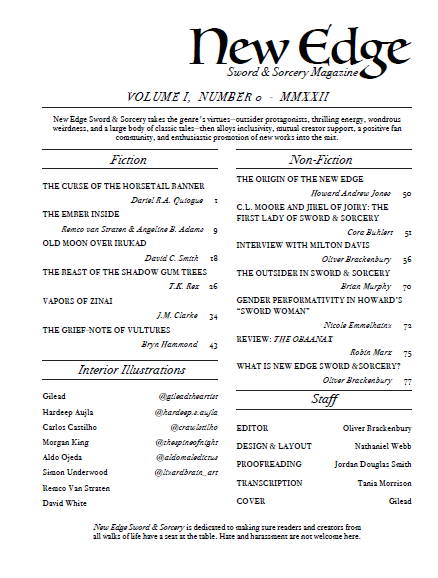
Wenden wir uns nun also endlich dem Inhalt des Magazins zu.
The Curse of the Horsetail Banner von Dariel R.A. Quiogue ist eine passable, aber nicht besonders innovative oder originelle S&S - Geschichte -- trotz des "mongolischen" Settings.
Durch die Intrigen seines verräterischen Blutsbruders Jungar ist der ehemalige Khan Timur Orhan zum Vogelfreien geworden und befindet sich nun auf der Flucht durch die Steppe. Zufällig verschlägt es ihn dabei in eine Region, die für die Stämme eigentlich tabu ist, befindet sich dort doch das Grabmal des legendären Toktengri. Doch als er erschreckt feststellen muss, dass die letzte Ruhestädte des Großkhans von einem Trupp Soldaten aus Wulong (~China) entweiht und das Pferdeschweifbanner des Eroberers geraubt wurde, macht er sich alsbald an die Verfolgung der fremdländischen Frevler. Zumal er überzeugt davon ist, dass ihm die Magie des Banners zum Triumph über den verhassten Jungar verhelfen werde. Als sich ihm auf der Jagd der Adler Zunjebei hinzugesellt, wirkt das beinah wie ein göttliches Omen. Weder die schwarzmagischen Künste des Eunuchen Lao Cheng noch die Truppen des Kaiserreiches werden ihn aufhalten können!
Natürlich ist es stets erfreulich, wenn eine Sword & Sorcery - Geschichte einmal pseudoeuropäische Gefilde verlässt und dabei nicht in die Falle des Exotismus tappt. Aber so revolutionär wie in den 70ern/80ern bei Charles R. Saunders' Nyumbani - Erzählungen oder Jessica Amanda Salmonsons Tomoe Gozen - Romanen ist das heute sicher nicht mehr. Und da meine persönliche Vorliebe ohnehin eher bei der "städtischen" Gauner- & Halunkenvariante des Subgenres liegt, stellte The Curse of the Horsetail Banner für mich nicht gerade einen fulminanten Auftakt dar.
The Ember Inside von Remco van Straten & Angeline B. Adams war da schon eher das, was ich mir unter "New Edge" vorgestellt hatte. Clever, thought-provoking und elegant erzählt.
Die wandernde Dichterin Ymke, ihre Partnerin, die Kriegerin Kaila, und ihr Kumpel Sebastien scheinen eine Art Gaunertrio zu sein. Aber darauf bekommen wir in der Geschichte nur vage Andeutungen. Eines Tages erhält Ymke eine Einladung von dem berühmten Dichter Sigismond, Verfasser des populären Epos Lay of Bärsk the Bloodied, das sie offenbar für ziemlichen Schund hält, auch wenn Kaila großen Spaß daran zu haben scheint.
Sigismond hat offenbar das Wohlwollen seiner reichen und blaublütigen Patrone verloren. Die junge Generation ist nicht länger an den immer gleichen blutrünstigen Räuberpistolen interessiert.
‘Is this what’s best in life?’ one duke’s daughter asked one evening. ‘Murder and violence, boots sliding over innards? What is the value in all of this? Where is the humanity?’Also will er ihnen etwas anderes bieten:
What I want, Ymke, is your story. They want humanity? I shall give them the true story of a girl who survived the war-torn wasteland of Cruonhinga and somehow made it in the world outside. A brave cripple -- they’ll love it. You of all people must know this. People love to compare themselves to the less fortunate, to believe they would offer succour, sanctuary, to such a person if given the chance.Unsere Protagonistin ist von dieser Idee allerdings überhaupt nicht begeistert. Erstens sei das ganz und gar keine adäquate Beschreibung ihres Lebens und zweitens habe sie keine Lust, das dasselbe auf "a tale of pity or admonishment" reduziert werde. Doch Sigismond braucht seine Story und um sie zu bekommen, setzt er Ymke kurzerhand unter Drogen.
Was folgt ist eine Reihe von (scheinbaren) Episoden aus ihrem Leben: Die ungewollte Heirat mit einem Großgrundbesitzer; die Geburt von zwei Söhnen, die sie nie zu lieben vermochte; die Flucht in Tagträume von einem freien Leben; das beständige Lodern und Anwachsen einer wütenden Flamme in ihrem Inneren; Szenen von Krieg und Gewalt; die erste Begegnung mit Kale (Kaila); und schließlich der blutige Befreiungsschlag, wenn sie ihren Gatten tötet und dem dumpfen Leben eines Eheweibs entkommt.
Sigismond ist ganz und gar nicht zufrieden:
Alack, I cannot use any of it. You have no talent for tragedy, Ymke! I wanted meekness, a story to make others weep. You disapprove of my Bärsk, and yet you gave me such hatred and bloodshed!Doch am Ende erfahren wir, dass das überhaupt nicht Ymkes reale Lebensgeschichte war. Zu der aufgezwungenen Ehe ist es in Wirklichkeit nie gekommen. Weshalb sie sich auch nicht auf so gewaltsame Art selbst befreien musste.
The Ember Inside enthält eine ganze Reihe interessanter Ideen. So geht es u.a. sicher darum, wie das Schicksal Marginalisierter als Material für klischeehafte Stories missbraucht und dabei entstellt werden kann. Doch für mich ist die Erzählung vor allem eine intelligente Reflexion über die Art von Geschichten, die wir erzählen und hören wollen. Sigismonds Bärsk scheint für das klassische Blood & Thunder zu stehen. Dem wird anfangs mangelnde Humanität und Realitätsferne vorgeworfen. Doch die ebenso klassische Emanzipationsgeschichte Ymkes entpuppt sich am Ende gleichfalls als "unecht", mithin bloß als eine andere Art von Klischee. Aber das nimmt ihr nicht ihre Daseinsberechtigung. So falsch es auch ist, wenn wir das Leben realer Menschen auf solche simplistischen Formeln reduzieren (ganz gleich ob rührseliges Melodrama oder wütende Story von Unterdrückung & Selbstbefreiung), Geschichten dieser Art können uns berühren und Ausdruck sehr tiefer Emotionen sein. Weshalb Ymke am Ende sogar ihr (möglicherweise etwas vorschnelles) Urteil über Bärsk in Frage stellt. Was selbstredend nicht das Verhalten von Sigismond entschuldigt, der seine gerechte Strafe erhält.
Old Moon Over Irukad von David C. Smith ist im Vergleich dazu wieder ziemlich klassische Sword & Sorcery - Kost: Ein diebisches Protagonistenpaar; ein verfallener Tempel; ein verräterischer Priester; vampirische Ungeheuer etc. Wenn ich mehr Spaß mit ihr hatte als mit Curse of the Horsetail Banner, dann weil sie meinen persönlichen Vorlieben entgegenkommt. Virissa und Edrion sind sympathische Halunken. Die Story beginnt und endet in einer Kneipe. Salz wird zur Abwehr von schwarzer Magie durch die Gegend geworfen. Und am Ende ist es der korpulente Schwertkämpfer Malon (Edrions Liebhaber), der die Situation rettet. Heldin wie Held sind queer, was für die eigentliche Handlung aber keine Rolle spielt. Doch gerade diese Selbstverständlichkeit ist ja durchaus begrüßenswert.
Hinzu kommt, dass David C. Smith als Verfasser des Oron / Attluma -Zyklus und Co-Autor der Red Sonja - Bücher ein echter Sword & Sorcery - Veteran ist. Seine Geschichte wirkt deshalb auch ein bisschen wie eine Art Statement, dass die "New Edge" kein aggressiver Bruch mit der vorhandenen Tradition sein will und auch deren Vertreter*innen einen Platz in ihr haben können.
The Beast of the Shadow Gum Trees von T.K. Rex entfernt sich sicher am weitesten von dem, was man sich klassischerweise unter Sword & Sorcery vorstellt.
Moth ist eine Art Naturgeist, der aus Liebe zu dem Barden Amas menschliche Gestalt angenommen hat. Als sein Partner nach vielen Jahren stirbt, wünscht er sich selbsts nichts sehnlicher als den Frieden des Todes. Doch dieser wird ihm verwehrt und das Meer spült ihn stattdessen an die Küste eines fremden Landes. Dort begegnet er einem Einhorn, das gegen die von den Menschen hier vor Zeiten angepflanzten Wälder ankämpft, die das ursprüngliche Chaparral-Ökosystem (ein Begriff, den der Text leider wirklich benutzt) zu zerstören drohen.
Die Geschichte ist das deutlichste Beispiel für die Experimentierfreude, die Brackenbury mit der "New Edge" verbindet. Sie dürfte gemeint sein, wenn er in seinem Gespräch mit Harrington erwähnt: "There’s also been some exciting talk already about messing around with
non-Western storytelling structures, and themes you don’t often come
across in S&S, such as environmentalism." und "Nobody will mistake the tale for an REH story, it leans more into the
mythic/weird side of the genre, and I think that’s plenty fine." Ich habe keinerlei Probleme mit so etwas, fühle mich dabei vielmehr an Jessica Amanda Salmonsons Bemühungen erinnert, die Grenzen der Heroic Fantasy in Amazons! stilistisch-inhaltlich zu erweitern. Und mit Stories wie Jaine Saint's Travails von Josephine Saxton oder The Woman Who Loved The Moon von Elizabeth A. Lynn enthielt ja auch diese 70er Jahre - Anthologie bereits so manches, was engstirnige S&S-Fans vermutlich niemals dem Subgenre zuordnen würden.
Was The Beast of the Shadow Gum Trees besonders auszeichnet ist die poetische und elegant rhythmisierte Sprache. Liest man die Geschichte laut, verfällt man dabei ziemlich schnell in eine Artt melodischen Singsang. Zwar enthält die Story den bei einer "Öko-Erzählung" beinah unausweichlichen Seitenhieb auf "Fortschritt" und "Wachstum": "The rate of new inventions has begun to build upon itself, and there are humans who believe that power comes from endless growth." Aber letztenendes geht es mehr um Themen von Vergänglichkeit, Trauer und Loslassen-Können. Und am Ende steht die Erkenntnis, dass Veränderung zwar stets von Verlust begleitet wird, doch dass das Leben/die Natur gerade dadurch immer wieder auch zu neuen Formen findet.
Vapors of Zinai von J..M. Clarke ist ein nettes Sword & Soul ("Afro - S&S") - Abenteuer, zu dem ich aber auch nur wenig zu sagen habe.
Kyembe, eine Art Magier "for hire", gelangt auf der Flucht vor seinem letzten (und seeehr unzufriedenen) Auftraggeber nicht ganz freiwillig ins verdammt ägyptisch anmutenden Reich von Zinai. Die ebenso schöne wie kluge und politisch gewandte Hohepriesterin Takhat rekrutiert ihn, um einer ziemlich ernsten Dämonenplage auf den Grund zu gehen, die nicht bloß reihenweise Todesopfer fordert, sondern dabei ist, Autorität und Macht der Priesterkaste zu untergraben.
Was mir an dieser Story besonders gut gefallen hat, ist die erfrischende Respektlosigkeit unseres Helden, dem jedwede Ehrfurcht vor Priestern, Göttern und Dämonen fremd ist. Dennoch erweist sich ihm Takhat als eine ebenbürtige Partnerin. Und dass der böse Dämonenbeschwörer nicht von Machtgier oder Rachsucht, sondern von Langeweile und Ennui angetrieben wird, war eine hübsche Abwechselung.
The Grief Note of Vultures von Bryn Hammond erwies sich sehr schnell als mein persönlicher Favorit. Die Geschichte beginnt mit der Schilderung einer gemeinsamen Mahlzeit. und schon das schien mir ein gutes Zeichen zu sein. Tatsächlich wird damit ein zentrales Element der Erzählung geschickt eingeführt: Die Reisegemeinschaft einer "multikulturellen" Karawane, die von unserer Heldin Angaj-Duzmut durch eine "zentralasiatische" Landschaft geführt wird.
Das gefällt mir gleich auf meheren Ebenen.
Angaj-Duzmut ist als Spross eines den Tanguten nachempfundenen Nomadenvolkes, die nach ihrer Flucht aus der reichen Stadt Fattimbet eine Zeit lang im "Commonwealth" der Vogelfreien und Gesetzlosen gelebt hat, eigentlich eine klassische Outsider - S&S - Heldin. Doch zugleich ist sie (für die Dauer dieses Abenteuers) Teil einer Gemeinschaft. Bei dieser handelt es sich aber eben gerade nicht um die archetypische "Heldengruppe", die auf irgendeiner Queste wäre. Die Karawane ist vielmehr eine aus der Arbeitswirklichkeit der Menschen geborene Zweckgemeinschaft. Dennoch verbindet ihre aus unterschiedlichsten Kulturkreisen, Religionsgruppen und Ethnien stammenden Mitglieder eine ganz selbstverständliche Kameradschaft. Es ist dieses "soziale" Setting das mir besonders zugesagt hat. Die zwischen den Reisegefährt*innen herrschende Toleranz ist dabei keineswegs ein "utopisches Wunschbild", sondern spiegelt die historische Realität der Gesellschaften wider, die während Antike und Mittelalter entlang der Seidenstraße existierten. Dort war es durchaus üblich, dass man in solch gemischten Karawanen reiste. Und Weltoffenheit ist (aus nachvollziehbaren Gründen) ein Charakteristikum vieler auf dem Handel basierender Zivilisationen.
Zugleich zeigt uns Bryn Hammond sehr schön, wie gut sich dieses "soziale" Setting mit Abenteuer und Action verbinden lässt. Denn wer weiß, was einem alles so auf einer solchen Reise begegnet? Im Falle von Angaj-Duzmut und ihren Gefährt*innen sind das monströse Geier, aus deren Körpern hier und da menschliche Gliedmaßen (oder auch mal ein Auge) wachsen. Die Gruppe sucht schließlich in einem (~buddhistischen) Tempel Zuflucht. Die Fresken im benachbarten Höhlenheiligtum sind nicht nur der Schlüssel zur Rettung, sondern heben noch einmal den quasi-anarchistischen Grundton der Geschichte hervor. Sind die dort abgebildeten Höllenqualen doch ganz den Martern und Bestrafungen nachempfunden, mit denen die Staatsgewalt ihre Untertanen "diszipliniert".
Die einzige Schwäche der Geschichte besteht für mich in der abschließenden Passage, in der uns Angaj-Duzmuts Geliebte, die "Räuberkönigin" des "Commonwealth", diesen Subtext noch einmal auf dem Silbertablett serviert. Was meiner Meinung nach nicht nötig gewesen wäre.
Zum Abschluss noch ein paar kurze Worte über den restlichen Inhalt des Magazins.
Über die kurzen Aufsätze The Origins of New Edge von Howard Andrew Jones und What is New Edge Sword and Sorcery von Oliver Brackenbury muss ich denk ich nichts weiter sagen. Cora Buhlert hat einen sehr schönen und informativen Essay über C.L. Moore and Jirel of Joiry beigesteuert hat, der mir große Freude bereitet hat, nicht nur weil wir beide große Fans der Autorin sind, sondern auch, weil ich es stets begrüße, wenn die Aufmerksamkeit einmal wieder darauf gelenkt wird, dass die Sword & Sorcery von Anfang ihre Heldinnen hatte. Dasselbe gilt für Nicole Emmelhainz' Gender Performativity in Howard's Sword Woman. Zwar erscheinen mir einige ihrer Argumente etwas konstruiert, doch im Großen und Ganzen bietet der Text eine interessante Herangehensweise an die Figur der Dark Agnes. Brackenburys Interview with Milton Davis, das man sich hier auch anhören kann, zeigt am Beispiel der Sword & Soul, dass es schon seit längerem Bemühungen um mehr Diversität in der S&S gibt. Und Brian Murphys Beitrag The Outsider in Sword & Sorcery zeigt am Beispiel einer ganzen Reihe klassischer S&S-Held*innen, dass das Subgenre schon immer den Geist des Nonkonformismus und Rebellentums in sich getragen hat. Einen Geist, den es immer wieder neu und in neuen Formen zu entfachen gilt.
Ob der "New Edge" als "Bewegung" eine große Zukunft beschieden ist, vage ich nicht zu prophezeien. Aber die Null-Nummer des Magazins stellt ohne Zweifel eine lohnende Lektüre dar. Bleibt nur zu hoffen, dass es Oliver Brackenbury tatsächlich gelingen wird, weitere Ausgaben von New Edge Sword and Sorcery auf die Beine zu stellen, die dann über Crowdfunding finanziert werden sollen.
Abonnieren
Posts (Atom)